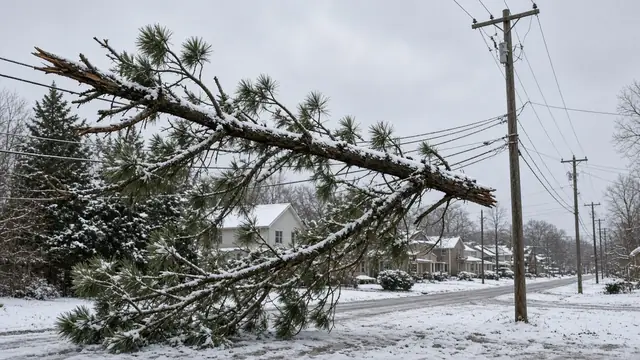
Published November 23, 2026 · Ocean County Tree Service
The first 10 minutes
- Assume the wire is live. You can't tell by looking whether a downed wire is carrying electricity, and a live one can severely injure or kill you (JCP&L's Emergency Management Guide (posted by Mendham Borough)).
- Keep at least 30 feet back from the wire, and don't go near the pole or anything it touches: fences, gutters, cars, branches. Keep pets away too. If the wire is near water, even a small puddle, stay well away.
- Call 911 if you actually see a wire down. JCP&L's guide says to call 911 first and then report it to JCP&L, and to give the exact location: town, street and house number, nearest cross street, and the pole number if you can read it safely. It also says not to assume a wire is down just because your power is out.
- Report it to the utility. JCP&L takes outage reports at 1-888-544-4877 or by texting OUT to 544487 (FirstEnergy's October 2025 nor'easter release). Atlantic City Electric takes downed-wire reports at 1-800-833-7476.
- Don't drive or walk under or over the line, and don't stand under damaged limbs. JCP&L warns that storm-weakened limbs can come down hours or days later, and the same goes for lines and poles.
If a wire falls on a car with people inside, JCP&L's guide says they should stay inside the vehicle until help arrives and gives further instructions, and nobody should touch the car. (For the insurance side, see tree fell on your car: who pays.)
JCP&L or Atlantic City Electric?
JCP&L serves most of Ocean County. Atlantic City Electric's service-territory list (Sustainable Jersey) names these Ocean County municipalities: Barnegat Light, Barnegat Township, Beach Haven, Eagleswood, Harvey Cedars, Lacey, Little Egg Harbor, Long Beach Township, Ocean Township, Ship Bottom, Stafford, Surf City and Tuckerton. If you live in one of those towns, check your electric bill to confirm which utility serves your street before you call.
Need a tree looked at or priced? Request a free quote in about a minute.
Get a free quoteWhich wire is it? Who handles what
| What the tree hit | Who handles it | What you do |
|---|---|---|
| Wires between poles (the main lines along the street) | The electric utility | Stay back, call 911 if a wire is down, report it to the utility. Don't touch the tree. |
| Service drop (the wire from the pole to your house) | The utility owns the drop and the meter | Report it. Don't pull limbs off it or cut near it. |
| Weatherhead, service cable, meter box or panel on your house | You, through a qualified electrician | Hire an electrician to make the repair; the service may need inspection before power is restored. |
| Phone or cable lines | Your phone or cable company | Call that company. FirstEnergy says it doesn't prune for phone or cable lines. |
| The rest of the tree on your lot, once lines are safe | You | A registered tree company cuts, removes and hauls it. |
Ownership split from JCP&L's June 2023 customer newsletter; phone and cable from FirstEnergy's vegetation management page.
That split comes straight from JCP&L's June 2023 customer newsletter: JCP&L is responsible for the service drop and the electric meter, and you own and must repair the weatherhead and insulator, the service entrance cable, the meter base, the fuse or breaker box and the house wiring. The newsletter adds that electrical work should only be done by a qualified electrician. On JCP&L's meter and service repair page, JCP&L says that if service is disconnected, the property owner must have a qualified electrician make the repair and have the service inspected for service to be restored.
What the utility will (and won't) do after a storm
Per FirstEnergy's vegetation management page, during storm work the priority is removing limbs from the wires, and FirstEnergy does not clean up the debris. The branches, trunk and stump left in your yard are yours. JCP&L's guide lays out its restoration order: crews first handle public-safety emergencies (removing tree hazards or isolating downed wires), then high-voltage lines and substations, critical facilities like hospitals, main distribution lines, the outages affecting the most customers, and finally outages affecting individual homes. That's why a single house with a torn service drop can wait longer than a whole street.
Report your own outage even if neighbors already did: JCP&L says the more reports it gets, the more accurately it can pin down the extent and cause.
When a tree company can start
Once the utility has cleared or de-energized the line, a tree company can take down what's left: a trunk leaning on the house, a split leader hanging over the driveway, limbs piled across the yard. A few points:
- Tree between the pole and your house? FirstEnergy says that if you want a tree removed between the pole and your home, it will need to disconnect the service, service fees may apply, and the homeowner is responsible for the actual removal (FirstEnergy's vegetation management page). Ask your tree company to coordinate that disconnect.
- Don't trim near lines yourself. JCP&L tells customers not to trim a tree that's near or touching a power line and never to let anything get within 10 feet of a line (JCP&L's June 2023 customer newsletter).
- Hire a registered company. New Jersey requires tree care businesses to register with the NJ Board of Tree Experts, keep at least one licensed person working full time, and show their NJTC number on their service vehicles. See how to check a NJ tree company's license.
- Running a generator? JCP&L's guide says never to connect one to your home's wiring without a proper isolation device, installed by a qualified electrician, because it could start a fire or electrocute a crew member restoring power. Keep generators outside, away from windows, doors and vents.
For the bigger picture, read what JCP&L will and won't do about trees near wires, tree fell on my house: what to do, and our emergency and storm tree removal page.
FAQ
Who do I call if a tree falls on a power line in Ocean County?
Call 911 first if a wire is down, then report it to your electric utility. For most of Ocean County that's JCP&L at 1-888-544-4877. Atlantic City Electric (1-800-833-7476) serves the southern towns on its territory list, such as Little Egg Harbor, Tuckerton, Stafford and the Long Beach Island towns. Your electric bill shows which one serves you.
How far should I stay from a downed power line?
At least 30 feet from the wire, per JCP&L, and don't go near the pole or anything the wire is touching. Keep pets away too, and stay well back if the wire is near water, even a small puddle.
Will JCP&L remove the tree from my yard after a storm?
No. During storm work, FirstEnergy (JCP&L's parent company) says its priority is getting limbs off the wires and it does not clean up the debris. The rest of the tree on your property is yours to deal with, usually with a tree company once the line is safe.
Who fixes the mast or weatherhead the tree ripped off my house?
You do, through a qualified electrician. JCP&L owns the service drop (pole to house) and the meter. You own the weatherhead, service entrance cable, meter base and panel.
Can a tree company cut a tree that is on a power line?
Not while the line is energized. Limbs on wires are the utility's job. A regular tree company should start once the utility has cleared or de-energized the line.
Sources
- JCP&L's Emergency Management Guide (posted by Mendham Borough)
- JCP&L's June 2023 customer newsletter
- FirstEnergy's vegetation management page
- JCP&L's meter and service repair page
- FirstEnergy's October 2025 nor'easter release
- Atlantic City Electric
- Atlantic City Electric's service-territory list (Sustainable Jersey)
- NJ Board of Tree Experts
More from the blog
- Ice-damaged tree: save or remove
- Tree fell on my car (NJ)
- Cutting a fallen tree yourself
- Snow-damaged arborvitae
- Southern pine beetle
- Brush & stump disposal
- Ice & snow load tree prep
- Fall cleanup before the first freeze
- Emerald ash borer
- Nor'easter tree damage
- 24/7 emergency tree removal
- Tree fell on my house (NJ)
- Stump grinding cost by size
- Leaning or split tree after a storm
- Stump sprouts & replanting
- Emergency tree removal: what to expect
- Fall pruning: what not to cut
- Winter burn & salt on evergreens
- Firewood from your trees
- 2026 tree removal prices
- Tree permits by town
- JCP&L and trees near wires
- Pines & oaks that fail in storms
- Insurance and tree removal
- Neighbor's overhanging branches
- Japanese black pine decline
- Storm tree cleanup: who hauls what
- Stump grinding cost in Toms River
- Spongy moth and your oaks
- How to check a tree company's license
- Pinelands tree clearing rules
- Nor'easter tree checklist
- Best time to remove or trim trees
- When a neighbor's tree falls
- All posts
Cost and permit guides
- Tree Removal Cost
- Stump Grinding Cost
- Tree Trimming Cost
- Storm Damage & Insurance
- Tree Permits by Town
- Dead Pine Trees
- Storm-Proofing Trees
- Hazard Tree Assessment
- Dying Ash & Oak Trees
- Crane Removal Cost
Sources are linked in the text and can change. This is general information, not legal, insurance or professional advice. Free referral service, not a tree company. We'll work to connect you with no more than one independent local tree company, which may pay us for the referral.