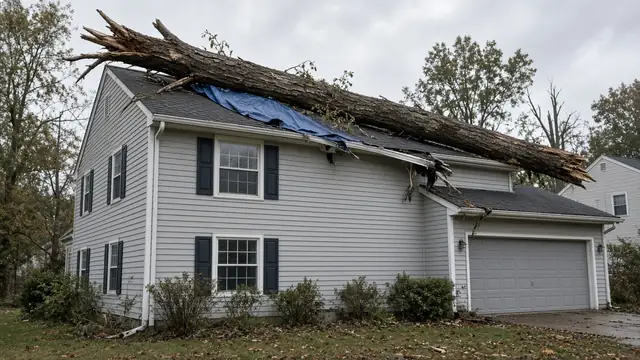
Published October 24, 2026 · Ocean County Tree Service
Step 1: Safety (the first 10 minutes)
- Get everyone out of the rooms under the tree and any room with a sagging or cracked ceiling.
- If a wire is involved, or you smell gas, leave the house and call 911 and JCP&L. Assume every down wire is live.
- Don't climb on the roof or cut the tree yourself. A trunk resting on a house is under tension and can shift or spring when cut.
- If water is coming in, shut off power to the wet area only if you can reach the panel safely and dry.
Step 2: Photos your insurer will want
- Wide shots of the house and tree from the street and the yard.
- Where the tree came from: the stump or root plate, the break, and any rot, hollow or dead wood. This matters if a neighbor's tree caused it.
- Every bit of damage: roof, gutters, siding, windows, fence, cars, and inside ceilings and walls.
- A short video walk-through, with the date. Keep photos of the cleanup and receipts too.
Need a tree looked at or priced? Request a free quote in about a minute.
Get a free quoteStep 3: What a standard NJ homeowners policy usually covers
| Item | Usually covered? | Notes |
|---|---|---|
| Damage to the house from a wind-blown tree | Yes, minus deductible | Covered peril hitting a covered structure |
| Removing the tree from the house | Yes, limited | Often $500 per tree / $1,000 per storm for debris removal |
| Emergency tarp and board-up | Yes | Reasonable steps to prevent further damage |
| Tree fell, hit nothing | Usually no | Some policies pay if it blocks a driveway |
| Stump grinding and replanting | Rarely | Treat as your cost |
| Flood damage (Sandy-style surge) | No, not on homeowners | Needs a separate flood policy |
General wording from the ISO HO 00 03 policy wording (Homesite comparison) and the Insurance Information Institute. Your policy, endorsements and deductible decide it. Complaints go to the NJ Department of Banking and Insurance. More: does homeowners insurance cover tree removal and our storm damage and insurance guide.
Step 4: When it's the neighbor's tree, who pays?
In New Jersey, a healthy tree that comes down in a storm is generally treated as an act of nature. You claim on your policy for your house, whoever owned the tree. The neighbor can be liable if they knew, or should have known, the tree was dead or dangerous and did nothing. NJ courts have applied that reasonable-care standard (D'Andrea v. Guglietta, 208 N.J. Super. 31 (App. Div. 1986); also Wegener v. Sugarman, 104 N.J.L. 26 (1927); overview from the New Jersey State Bar Foundation). Photos of rot, mushrooms or a dead crown help your insurer recover from the neighbor's insurer. Full explainer: who pays when a neighbor's tree falls.
Step 5: Getting the tree off safely
Hire a New Jersey Licensed Tree Care Operator with insurance. A tree on a roof is one of the most dangerous jobs in tree work, and big pines and oaks on Ocean County homes often need a crane tree removal to lift pieces off without more damage. Ask for an itemized invoice (removal from the structure, haul-away, stump) for the claim. See what to expect from an emergency tree call.
Permits for emergency removal
Local tree ordinances in towns like Toms River, Brick and Jackson regulate removing healthy trees. Many, like the NJDEP model tree ordinance, exempt trees that are an immediate danger, though some towns ask for notice or photos afterward. Check the town-by-town permit guide.
After the emergency
Have the rest of the yard checked, because trees that survived the same storm may be next (see pitch pine and oak failure warning signs and nor'easter tree damage guide). Related: 24/7 emergency tree removal, storm tree cleanup, emergency & storm tree removal.
FAQ
Does homeowners insurance cover a tree falling on my house in NJ?
Usually yes, when a covered peril like wind knocks the tree onto a covered structure. Standard HO-3 wording covers the damage to the house and pays a limited amount (often $500 per tree and $1,000 per storm) to remove the tree. Read your own policy and deductible.
My neighbor's tree fell on my house. Who pays?
In New Jersey, if a healthy tree falls in a storm, it's usually treated as an act of nature and you claim on your own policy. If the neighbor knew or should have known the tree was dead or dangerous, the neighbor may be liable. Your insurer may chase the neighbor's insurer.
Will insurance pay to remove a tree that fell but hit nothing?
Usually not, unless it blocks a driveway or a ramp for a disabled person, depending on your policy. Most policies pay for removal only when the tree damaged a covered structure.
Should I wait for the adjuster before removing the tree?
No. You're expected to prevent further damage. Photograph everything, then get the tree off the house and tarp the roof. Keep the invoices.
Do I need a permit to remove a tree that fell on my house?
A tree that's already down or is an immediate hazard is usually allowed under the emergency exemption in local tree ordinances, though some towns want notice. Keep your photos.
Is it safe to stay in the house?
Stay out of any room under the tree or with a cracked ceiling. If you smell gas, see sparks, or the structure is shifting, leave and call 911.
More from the blog
- Nor'easter tree damage
- 24/7 emergency tree removal
- Stump grinding cost by size
- Leaning or split tree after a storm
- Stump sprouts & replanting
- Emergency tree removal: what to expect
- Fall pruning: what not to cut
- Winter burn & salt on evergreens
- Firewood from your trees
- 2026 tree removal prices
- Tree permits by town
- JCP&L and trees near wires
- Pines & oaks that fail in storms
- Insurance and tree removal
- Neighbor's overhanging branches
- Japanese black pine decline
- Storm tree cleanup: who hauls what
- Stump grinding cost in Toms River
- Spongy moth and your oaks
- How to check a tree company's license
- Pinelands tree clearing rules
- Nor'easter tree checklist
- Best time to remove or trim trees
- When a neighbor's tree falls
- All posts
Cost and permit guides
- Tree Removal Cost
- Stump Grinding Cost
- Tree Trimming Cost
- Storm Damage & Insurance
- Tree Permits by Town
- Dead Pine Trees
- Storm-Proofing Trees
- Hazard Tree Assessment
- Dying Ash & Oak Trees
- Crane Removal Cost
Sources are linked in the text and can change. This is general information, not legal, insurance or professional advice. Free referral service, not a tree company. Your request goes to one independent local tree company, which may pay us for the referral.