Published October 27, 2026 · Ocean County Tree Service
What emerald ash borer is and why it matters here
EAB is a small, metallic green beetle from Asia. Its larvae tunnel under the bark and cut off the tree's flow of water and nutrients. According to the NJ Department of Agriculture, it was found in New Jersey in May 2014 in Somerset County, and it has spread statewide since. Most of New Jersey's wild ash grows in the northwest of the state, so in Ocean County the ash trees at risk are mostly planted yard and street trees, plus some ash along wetter stream edges. That's exactly where a dead tree can land on a roof, a car or a fence.
Is your tree an ash? A 30-second check
- Opposite branching: twigs and leaves grow in pairs straight across from each other, not staggered.
- Compound leaves: each leaf is made of several leaflets (often 5 to 9) along one stem.
- Diamond bark: mature ash has tight, criss-crossing ridges that form a diamond pattern.
- Not an ash: pitch pine, oaks, maples with simple leaves, and red cedar. Oaks here have their own problems; see spongy moth and oak trees.
Need a tree looked at or priced? Request a free quote in about a minute.
Get a free quoteSigns of EAB damage
The NJ Forest Service lists these signs. One alone isn't proof, but two or three together on an ash are a strong warning:
| Sign | What it looks like |
|---|---|
| D-shaped exit holes | Tiny (about 1/8 inch) holes with one flat side, where adult beetles chewed out |
| Woodpecker flecking | Patches of light-colored bark where birds stripped the outer layer to reach larvae |
| Galleries under bark | Winding, S-shaped tunnels you can see where bark has split or fallen off |
| Crown dieback | Thin leaves and bare branches starting at the top of the tree |
| Sprouts | Clusters of new shoots on the trunk or at the base of a stressed tree |
Treat or remove?
The NJ Forest Service says systemic insecticide treatments can protect individual ash trees, but they should be applied by a licensed pesticide applicator and work best on healthy trees, before or soon after infestation. NJDA's NJDA's EAB fact page lists soil treatment, trunk injection and bark sprays as the options.
- Treat when the tree is healthy or only lightly affected, it's in a spot you value (shade over the house, a specimen tree), and you're ready to repeat treatments on the schedule your applicator recommends.
- Remove when a large part of the crown is already dead, the tree leans over the house, driveway, road or wires, or you'd rather not commit to ongoing treatment. See our dead tree removal service.
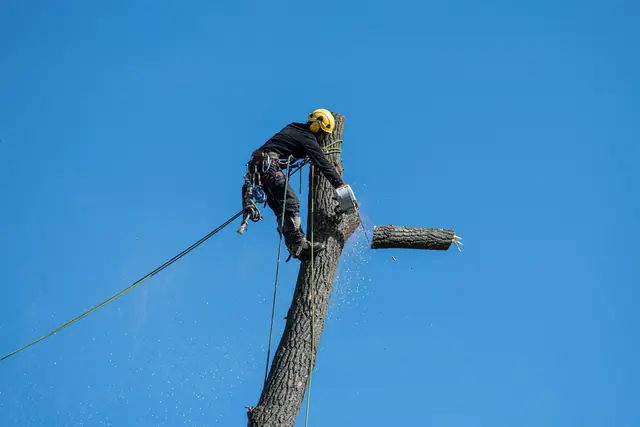
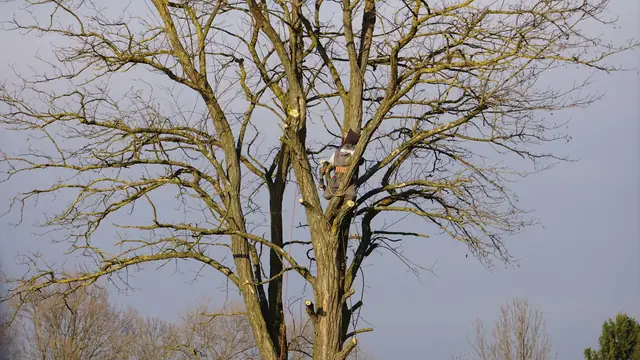
- Don't wait on a dead ash. Dead ash dries out and gets brittle, which makes it more dangerous for climbers and more likely to drop limbs in a nor'easter. Often that means it costs more to remove later.
Timing and what happens to the wood
NJDA's "What do I do with my trees" page recommends doing ash removals in fall and winter and chipping or debarking the wood before adult beetles come out, which NJDA puts at late April. Keep ash wood local: don't haul ash firewood to the shore house or a campground in another county. A tree that is a high safety risk should come down right away, whatever the month. Our best time to remove or trim trees post covers seasonal timing for other trees.
Permits and who to hire
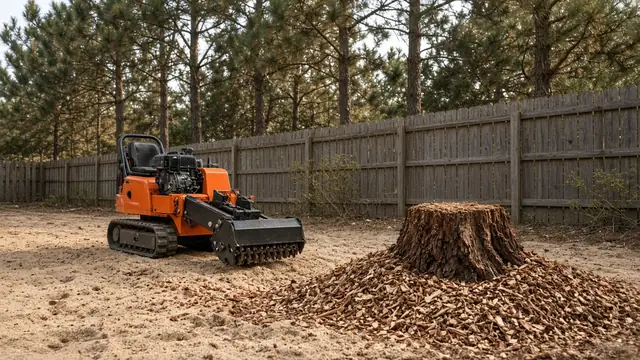
Many Ocean County towns require a permit to remove a tree, but several allow dead or hazardous trees with a waiver or a lower fee. Check your town on our town-by-town permit guide. Hire a company with a New Jersey Licensed Tree Care Operator on the job (how to check a NJ tree care license), and if you're treating, confirm the applicator holds a NJ pesticide license. After removal, stump grinding keeps the spot usable. You can report signs of the beetle to the NJ Department of Agriculture at 609-406-6939.
More from the blog
- Fall cleanup before the first freeze
- Nor'easter tree damage
- 24/7 emergency tree removal
- Tree fell on my house (NJ)
- Stump grinding cost by size
- Leaning or split tree after a storm
- Stump sprouts & replanting
- Emergency tree removal: what to expect
- Fall pruning: what not to cut
- Winter burn & salt on evergreens
- Firewood from your trees
- 2026 tree removal prices
- Tree permits by town
- JCP&L and trees near wires
- Pines & oaks that fail in storms
- Insurance and tree removal
- Neighbor's overhanging branches
- Japanese black pine decline
- Storm tree cleanup: who hauls what
- Stump grinding cost in Toms River
- Spongy moth and your oaks
- How to check a tree company's license
- Pinelands tree clearing rules
- Nor'easter tree checklist
- Best time to remove or trim trees
- When a neighbor's tree falls
- All posts
Cost and permit guides
- Tree Removal Cost
- Stump Grinding Cost
- Tree Trimming Cost
- Storm Damage & Insurance
- Tree Permits by Town
- Dead Pine Trees
- Storm-Proofing Trees
- Hazard Tree Assessment
- Dying Ash & Oak Trees
- Crane Removal Cost
Sources are linked in the text and can change. This is general information, not legal, insurance or professional advice. Free referral service, not a tree company. Your request goes to one independent local tree company, which may pay us for the referral.