Warning signs you can check yourself
The International Society of Arboriculture lists these signs of a tree that may fail. Walk around the tree and look up and down:
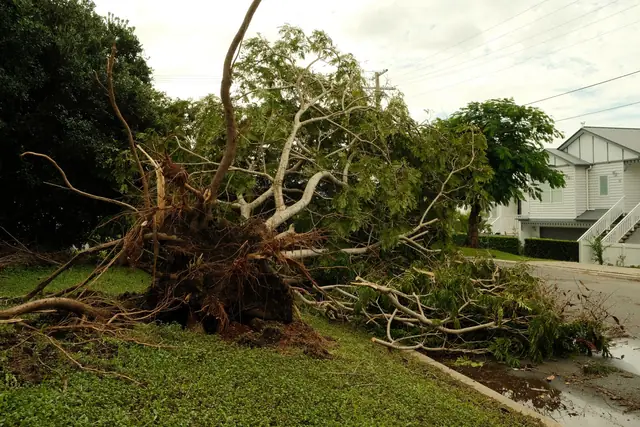
- Dead trees and dead branches, especially large ones over the house, driveway or play areas.
- Cracks in the trunk or major limbs.
- Weak forks, where two trunks of similar size meet in a tight V with bark pinched between them.
- Decay: cavities, soft or crumbly wood, or mushrooms and conks on the trunk or roots.
- A new or worsening lean, particularly with cracked or lifted soil on the opposite side.
- Root damage from trenching, driveways, pools or grade changes.
A defect only matters if something is in the way. A dead pine in the woods is a low risk; the same pine over a bedroom is not. Arborists call that the target.
Who can assess a tree in New Jersey
New Jersey licenses two kinds of tree professionals. According to Rutgers NJAES fact sheet FS019, a Licensed Tree Care Operator (LTCO) covers pruning, removal and stump grinding, while a Licensed Tree Expert (LTE) covers all of that plus consulting, diagnosis, and tree assessment and risk management. For a formal opinion on whether a tree is hazardous, ask for an LTE. Every tree care business in the state has to be registered with the NJ Board of Tree Experts, and Rutgers notes that registered businesses must carry at least $1,000,000 in liability insurance plus workers' compensation. Many risk assessors also hold the ISA's voluntary Tree Risk Assessment Qualification (TRAQ).
Want a price for your tree? It takes about a minute.
Get a free quoteWhat an assessment involves
- Visual inspection from the ground, all the way around the tree: crown, trunk, root flare and the surrounding site.
- Closer checks if needed: sounding the trunk with a mallet, probing decay, or, for valuable trees, specialized tools to measure internal decay, or a climbing inspection of the upper crown.
- Risk rating based on how likely the tree or part is to fail, what it would hit, and the consequences.
- Recommendations: remove, prune out the defect, cable or brace, reduce the crown, or monitor and re-check.
- A written report with photos, if you ask for one. That's the part that matters for permits and insurance.
Why a written report can save money here
Several Ocean County towns go easier on dangerous trees, but they want proof:
- Point Pleasant Borough: hazard trees can be exempt from the $150 fee and replacement with documentation such as a report from a NJ Licensed Tree Expert (Point Pleasant Removal of Trees ordinance).
- Tuckerton: hazard trees can be removed with no fee or replacement when a certified arborist or NJ Licensed Tree Expert, or the borough, confirms the hazard (Tuckerton Ch. 244).
- Stafford: nuisance trees (dead, dying, diseased, or damaging structures) can be removed with no fee or replacement (Stafford Ch. 194).
- Toms River: the permit fee is waived for removing a dead tree (Toms River Township).
See the town-by-town permit guide for your town.
Cost and timing
Rutgers notes there may be a charge for a consultation, assessment or estimate (Rutgers NJAES fact sheet FS019). A quick look during a free removal estimate is common, but a formal written risk assessment is usually a paid service. If removal is recommended, Rutgers suggests the estimate should say why. Getting more than one opinion on a big, valuable tree is reasonable. Late fall and winter, after leaf drop, is a good time to have deciduous trees looked at because the structure is easy to see.
After the assessment
- If removal is recommended, request a quote and include the report or photos.
- If pruning or cabling is recommended, see tree trimming.
- If it's a pine, read our dead pine guide; if it's an ash or oak, see dying ash and oak trees.
Who can do a tree risk assessment in New Jersey?
A NJ Licensed Tree Expert (LTE). The state's licensing law lists tree assessment and risk management among LTE services; Licensed Tree Care Operators cover pruning, removal and stump grinding.
Is a hazard tree assessment free?
A quick opinion during a removal estimate often is, but a formal written assessment is usually a paid consultation. Ask about the fee up front.
Can a written assessment help with my town's permit?
Yes in several towns. Point Pleasant, Tuckerton and Stafford exempt documented hazard trees from some fees or replacement, and Toms River waives its $75 permit fee for removing a dead tree.
More guides
- Tree Removal Cost
- Stump Grinding Cost
- Tree Trimming Cost
- Storm Damage & Insurance
- Tree Permits by Town
- Dead Pine Trees
- Storm-Proofing Trees
- Dying Ash & Oak Trees
Areas we cover
- Toms River
- Brick
- Lakewood
- Jackson
- Manchester
- Berkeley
- Lacey
- Barnegat
- Stafford
- Little Egg Harbor
- Point Pleasant
- Point Pleasant Beach
- Plumsted
- Beachwood
- Ocean Township
- Island Heights
- Lakehurst
- Pine Beach
- Tuckerton
Last updated October 18, 2026. Prices and rules come from the cited third-party and municipal sources and can change. They aren't quotes or legal advice. Free referral service, not a tree company. Your request goes to one independent local tree company, which may pay us for the referral.