Published October 19, 2026 · Ocean County Tree Service
Why our trees fail the way they do
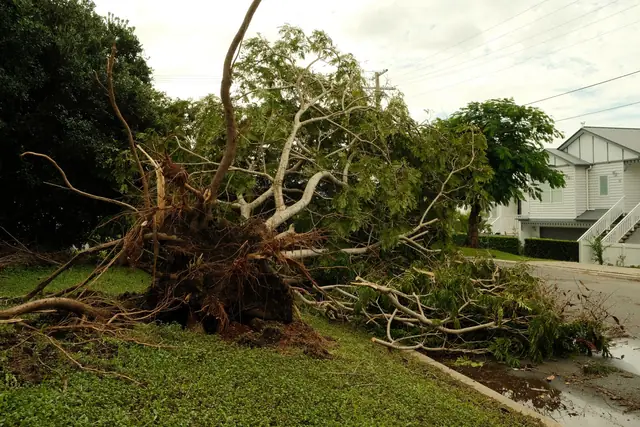
Ocean County trees grow in sand. On deep, dry sand, USDA Forest Service Station Paper 119 found pitch pine roots reach 8 to 9 feet deep, which is why the species is called relatively wind-firm. On wet sites, roots can be limited to 3 to 5 feet. Nor'easters bring long periods of wind with soaked ground (National Weather Service), so trees on low or lagoon-side lots, or where roots were trenched for a driveway or septic, tip over root plate and all. Sandy (2012) showed how surge and salt can weaken roots for years afterward (National Hurricane Center's Sandy report).
Risk by species
| Tree | Common failure | What raises the risk | Source |
|---|---|---|---|
| Black oak | Trunk or branch breakage at decay | Rot, especially behind old fire scars | a Pine Barrens treefall study in Ecology |
| Chestnut oak | Trunk breakage | Rot linked to fire scarring | a Pine Barrens treefall study in Ecology |
| White & other oaks | Decline, then dieback and limb drop | Spongy moth defoliation, drought, two-lined chestnut borer | Rutgers NJAES fact sheet FS1392 |
| Pitch pine | Snapped trunk or whole-tree uprooting | Heart rot (Phellinus pini, mostly in trees 75+ years), wet or shallow soil, cut roots | USDA Silvics of North America: pitch pine |
| Dead pitch pine | Snaps as it dries and gets brittle | Southern pine beetle, drought | NJDEP |
Summaries of the cited research. Individual trees vary; an on-site assessment is the only reliable call.
Need a tree looked at or priced? Request a free quote in about a minute.
Get a free quoteThe warning-sign checklist
- Fungus: mushrooms or shelf-like conks on the trunk or root flare mean internal decay.
- Cavities and fire scars: common on Pinelands-edge lots in Jackson, Manchester, Lacey and Barnegat. In the Pine Barrens study, fire scars led to rot, and rot led to failure.
- Cracks and seams in the trunk, or a weak V-shaped fork with bark pinched inside.
- A new lean or soil heaving or cracking on the side away from the lean.
- Cut or buried roots: new driveway, septic, pool or regrading within the drip line in the last 10 years.
- Dead wood: a dead top, hanging limbs, or a crown much thinner than its neighbors.
- Brown pines: red or brown needles across the whole tree mean it's dead or dying (dead pine guide).
Source for these signs: ISA's Recognizing Tree Risk.
What to do with a suspect tree
- Check what it would hit: house, bedroom, driveway, power line, neighbor's roof.
- Get it assessed by an ISA Certified Arborist or NJ Licensed Tree Expert before storm season (hazard tree assessment).
- Options run from deadwood removal and crown reduction to full removal. See tree trimming and dead tree removal.
- Document it with photos. A dead or hazard tree is fee-waived or exempt in most town permit rules, and records help with insurance and neighbor disputes.
Local pages: Toms River, Brick, Jackson, Lakewood, Manchester, Berkeley. Storm coming? Use our nor'easter checklist.
FAQ
Are pitch pines likely to fall in a storm?
Healthy pitch pines on deep, dry sand are fairly wind-firm because their roots can reach 8 to 9 feet down. Risk rises on wet or shallow soils, after root damage from construction, and when the trunk has heart rot or fire scars.
Which oaks fail most in Ocean County storms?
In a Pine Barrens storm study, the only species damaged were chestnut oak and black oak, and the damaged trees were more rotted than undamaged ones. Trees with fire scars were much more likely to have rot.
What are the warning signs a tree may fail in a nor'easter?
Mushrooms or conks on the trunk or root flare, cavities, cracks, dead branches, a new lean or heaving soil on one side, roots cut by construction, and a thinning or dead crown.
Should I remove a tree just because it's tall and near the house?
Not by itself. Height near a target raises the stakes, but defects drive failure. Have an ISA Certified Arborist or NJ Licensed Tree Expert assess it.
More from the blog
- Fall pruning: what not to cut
- Winter burn & salt on evergreens
- Firewood from your trees
- 2026 tree removal prices
- Tree permits by town
- JCP&L and trees near wires
- Insurance and tree removal
- Neighbor's overhanging branches
- Nor'easter tree checklist
- Best time to remove or trim trees
- When a neighbor's tree falls
- Spongy moth and your oaks
- How to check a tree company's license
- Pinelands tree clearing rules
- Storm tree cleanup: who hauls what
- Stump grinding cost in Toms River
- Japanese black pine decline
- All posts
Cost and permit guides
- Tree Removal Cost
- Stump Grinding Cost
- Tree Trimming Cost
- Storm Damage & Insurance
- Tree Permits by Town
- Dead Pine Trees
- Storm-Proofing Trees
- Hazard Tree Assessment
- Dying Ash & Oak Trees
- Crane Removal Cost
Sources are linked in the text and can change. This is general information, not legal, insurance or professional advice. Free referral service, not a tree company. Your request goes to one independent local tree company, which may pay us for the referral.