Published October 24, 2026 · Ocean County Tree Service
Why Ocean County trees fail in nor'easters
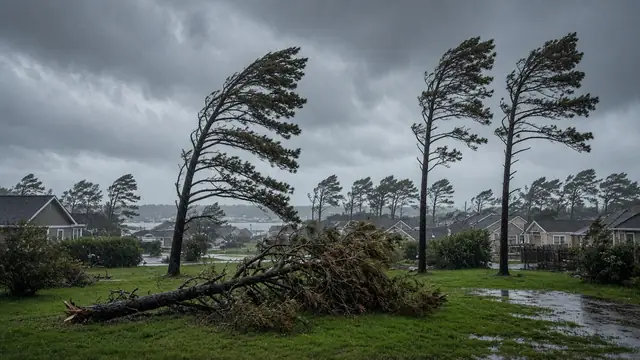
A nor'easter isn't a quick thunderstorm. The National Weather Service describes it as a coastal storm with strong northeast winds that can last through several tide cycles. Here that means hours of wind on soil that's already soaked.
- Pitch pine in Pine Barrens sand. Pitch pine is the signature tree of inland Ocean County (USDA Silvics of North America: pitch pine). In wet, loose sand the root plate can slip and the whole tree tips over. A a Pine Barrens treefall study in Ecology found wind-thrown trees are a normal part of Pine Barrens forests. In a yard, that tree lands on a roof, fence or car.
- Old oaks. Oaks in older Toms River, Lakewood and Brick neighborhoods tend to drop big limbs or snap where decay has hollowed the trunk. Oaks weakened by defoliation are more at risk (Rutgers NJAES fact sheet FS1392).
- Salt and flooding at the shore. On the barrier island and bay-front lots, saltwater flooding and salt spray stress trees for years afterward, and dying trees fail in the next storm.
The Sandy lesson
Sandy came ashore near Brigantine on October 29, 2012 (National Hurricane Center's Sandy report). It wasn't a classic nor'easter, but it hit like one here: days of wind from the east and northeast, storm surge on the barrier island and bay towns, and huge numbers of downed trees and power lines across Ocean County. The trees that failed were mostly the ones that were already compromised: dead or dying pines, decayed oaks, and trees leaning over houses. Storms since then have shown the same pattern. That's why checking your trees before the next storm (see our nor'easter tree checklist and storm-prep guide) pays off.
Need a tree looked at or priced? Request a free quote in about a minute.
Get a free quotePost-storm yard check (10 minutes, from the ground)
| What you see | What it can mean | How urgent |
|---|---|---|
| Tree or limb touching a wire | Can be energized | Stay 30+ ft away. Report to the utility now |
| Tree or big limb on the roof | Structural and water damage | Same day: emergency removal + tarp |
| Soil heaved or cracked on one side of the trunk | Root plate has moved | Same day: keep people out of the fall zone |
| Broken limb hanging in the crown (a 'hanger') | Can drop without warning | Within a day or two; don't walk under it |
| New lean, split trunk or crack at a fork | Structural failure started | Get it looked at this week |
| Bark stripped, small branches down | Mostly cosmetic | Normal cleanup |
Based on the warning signs in ISA's Recognizing Tree Risk. For detail on specific defects, see pitch pine and oak failure warning signs and leaning or split tree: save or remove.
What to do, in order
- Safety. Assume every down wire is live. Call 911 for immediate danger, then JCP&L (FirstEnergy's Report a Tree Problem page; see what JCP&L will and won't do). Don't run a chainsaw on a tree under tension.
- Photos. Wide shots and close-ups of the tree, the break or root plate, and every bit of damage, before anything is moved.
- Stop further damage. Getting the tree off the roof and tarping is usually expected and reimbursable. Keep invoices.
- Call your insurer if the tree hit a covered structure (see storm damage and insurance guide).
- Get a licensed, insured company for anything leaning, hung up or on a structure. Trees on houses often need a crane tree removal.
- Check permits for anything that isn't an emergency (our town-by-town permit guide).
Where we take storm requests
We take requests from across Ocean County, including Toms River, Brick, Jackson, Lakewood, Manchester, Berkeley, Lacey, Stafford, Barnegat, Little Egg Harbor, Point Pleasant, plus LBI, Seaside and the rest of the shore. See our emergency & storm tree removal page, 24/7 emergency tree removal, and if a tree is already on the house, tree fell on my house: what to do.
FAQ
Why do so many pines fall in Ocean County nor'easters?
Pitch pine grows in deep, sandy Pine Barrens soil. When days of rain saturate that sand and a nor'easter blows hard for a full tide cycle or longer, the root plate can lose its grip and the whole tree tips. Shallow roots, a lean toward the house and a dense crown all raise the risk.
Are oaks safer than pines in a storm?
Not always. Oaks rarely tip over whole, but old oaks drop heavy limbs, and oaks with trunk decay, cavities or mushrooms at the base can snap. Leafed-out oaks catch more wind in early-fall storms than in winter.
What should I do right after a nor'easter damages a tree?
Stay away from any tree touching a wire and report it to your utility. Photograph everything before it's moved, keep people off a roof with a tree on it, and get a tree company to look at hangers, split trunks and lifted root plates before you clean up underneath.
Is a tree with a lifted root plate safe to leave?
Usually not. If the soil on one side has heaved up or cracked after a storm, the roots have moved. Keep people out of the fall zone and have it looked at the same day.
Do I need a permit to remove a storm-damaged tree in Ocean County?
Many local tree ordinances, and the NJDEP model ordinance they're often based on, allow emergency removal of a tree that is an immediate danger, but some towns still want notice or photos afterward. Check your town's rules on our permit guide and keep your photos.
How much does storm tree removal cost?
More than a planned removal: tangled, leaning or hung-up trees need more rigging and sometimes a crane, and after a big storm demand spikes. Get a written estimate and an itemized invoice for your insurance claim.
More from the blog
- 24/7 emergency tree removal
- Tree fell on my house (NJ)
- Stump grinding cost by size
- Leaning or split tree after a storm
- Stump sprouts & replanting
- Emergency tree removal: what to expect
- Fall pruning: what not to cut
- Winter burn & salt on evergreens
- Firewood from your trees
- 2026 tree removal prices
- Tree permits by town
- JCP&L and trees near wires
- Pines & oaks that fail in storms
- Insurance and tree removal
- Neighbor's overhanging branches
- Japanese black pine decline
- Storm tree cleanup: who hauls what
- Stump grinding cost in Toms River
- Spongy moth and your oaks
- How to check a tree company's license
- Pinelands tree clearing rules
- Nor'easter tree checklist
- Best time to remove or trim trees
- When a neighbor's tree falls
- All posts
Cost and permit guides
- Tree Removal Cost
- Stump Grinding Cost
- Tree Trimming Cost
- Storm Damage & Insurance
- Tree Permits by Town
- Dead Pine Trees
- Storm-Proofing Trees
- Hazard Tree Assessment
- Dying Ash & Oak Trees
- Crane Removal Cost
Sources are linked in the text and can change. This is general information, not legal, insurance or professional advice. Free referral service, not a tree company. Your request goes to one independent local tree company, which may pay us for the referral.