Published November 23, 2026 · Ocean County Tree Service
First, wait for the ice to melt
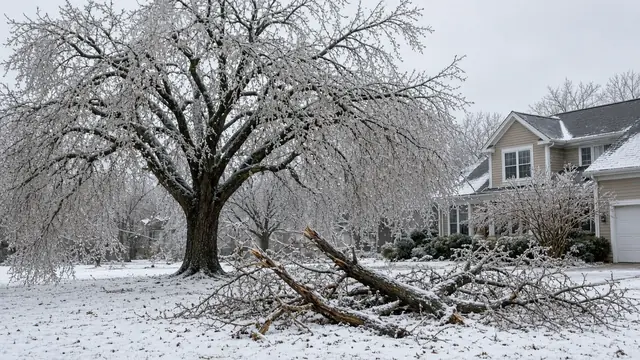
Don't beat or shake ice off branches. K-State Research and Extension says knocking off ice or frozen-on snow breaks branches and pulls off needles; only fresh, powdery snow should be brushed off gently. Stay out from under loaded trees until the ice is gone, and keep clear of anything touching a wire (see tree on a power line after a storm). Once it melts, walk the yard from a safe distance and photograph every damaged tree for your records and your insurer.
The decision table
Trees and Ice Storms (Hauer, Dawson & Werner, 2nd ed.) groups storm damage into five types: broken branches, trunk bending, splitting of main (codominant) stems, complete trunk failure, and tipping or uprooting. Its Table 3 turns that into a simple guide:
| What you see | Usual call | Why |
|---|---|---|
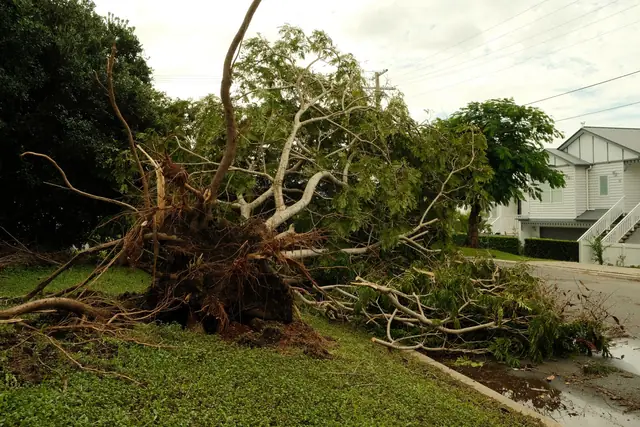
| Uprooted or tipped tree | Remove | Structural integrity is compromised. |
| Trunk snapped (complete trunk failure) | Remove | Structural integrity is compromised. |
| Broken branches over more than 50% of the crown | Remove | Damage this severe prevents adequate recovery and raises the risk of further failure. |
| Broken branches over 30–50% of the crown | Repair, case by case | Location and severity of the damage, species and age all have to be weighed. |
| Broken branches under 30% of the crown | Repair | Prune back to proper cuts and let the tree recover. |
| Split codominant stems (a fork pulled apart) | Repair or remove | Pruning plus cables and braces can work; on large, older trees a severe split usually means removing that branch. |
| Trunk bent by ice, not broken | Usually keep | Most return to their pre-storm form once the ice melts. |
Adapted from Table 3 and the Recovery section of Trees and Ice Storms (2nd ed.). Location of the damage, species, age and decay all change the call.
Other extension services land in the same place. Texas A&M Forest Service calls 50 percent of the crown a good rule of thumb for survivability, and NC State Extension lists trees with more than half the canopy damaged, major limbs broken, extensive trunk damage or a broken central leader as candidates for removal. Oklahoma State University Extension says that if more than 50 percent of the crown is damaged, the likelihood of survival is small.
Need a tree looked at or priced? Request a free quote in about a minute.
Get a free quoteDamage that's easy to miss
- Hidden cracks. Ice can crack a branch lengthwise near where it attaches without breaking it. Trees and Ice Storms (Hauer, Dawson & Werner, 2nd ed.) says those branches must be removed as soon as they're found because they have a high potential to fail.
- Bark torn down the trunk. Oklahoma State University Extension notes that a common, life-shortening injury is a large limb breaking and peeling bark down the trunk, which leaves a wound open to disease.
- Bends low on the trunk. A bend in the lower third of the trunk can create internal cracks that become a weak point later, so Trees and Ice Storms says those trees warrant frequent monitoring. Small bent trees can be staked upright while the stem strengthens.
- Old decay exposed by the break. The publication says the decayed or discolored wood exposed by the damage should influence whether a limb or tree is kept, and that older trees have less capacity to recover than young ones.
Pitch pines, oaks and Ocean County snow
Heavy, wet nor'easter snow is a bigger worry here than glaze ice. In the March 21, 2018 nor'easter (Winter Storm Toby), Lacey Township reported 15 inches of snow, the highest total in the state for that storm, and about 87,000 customers in central and southern New Jersey lost power (NJ Board of Public Utilities report on the March 2018 nor'easters). In December 2010, Brick Township measured 30 inches, the greatest total of that storm (National Weather Service Mount Holly storm summary). Inland areas also run colder: the Office of the New Jersey State Climatologist (Rutgers) says sandy Pine Barrens soils lose heat fast on clear nights and can be 15 to 20 degrees cooler than nearby areas.
- Pitch pine. The ice publication notes that in forests, pitch pine has an excellent ability to sprout and grow new branches after ice damage. A pine over your roof is a different question. Oklahoma State University Extension says a pine without its leader spreads outward instead of growing up, and a side branch can sometimes be trained as a new leader. NC State Extension (Pender County) is blunter: pines and hickories whose main trunk fails will not recover. With a pine near the house, get a licensed tree expert's opinion rather than guessing.
- Oaks and shade trees. Texas A&M Forest Service says a mature shade tree can usually survive losing one major limb, as long as the broken branch is pruned back to the trunk and the wound is watched for decay in the months after.
- Arborvitae and other evergreen shrubs usually bend instead of breaking. See snow-bent or split arborvitae.
How to repair a keeper (and what not to do)
- Remove hazards first: hanging limbs, cracked branches and unstable trunks, per Oklahoma State University Extension.
- Prune to proper cuts. Oklahoma State says to cut broken limbs back to a branch at least one-third the diameter of the one being removed, cut just outside the branch collar, and use the three-cut method on big limbs so bark doesn't peel.
- Don't over-prune. NC State says to leave as many limbs as possible; the tree needs its leaves, and an uneven crown fills in within a few seasons.
- Never top the tree. Oklahoma State and NC State both warn against topping. NC State says that if topping is your only option, you're better off removing the tree and replacing it.
- Cabling and bracing a split fork is specialized work. The NJ Board of Tree Experts says a Licensed Tree Expert can do cabling, bracing and tree risk assessment, while a Licensed Tree Care Operator covers standard pruning, removal and stump grinding. See our hazard tree assessment guide.
Anything above shoulder height, on a ladder or near a wire belongs to a crew (see cutting up a fallen tree yourself). Before the next storm, see ice and snow load prep and tree trimming and pruning. For wind damage, see leaning or split tree after a storm.
FAQ
Should I remove a tree that lost a lot of branches in an ice storm?
It depends on how much. Trees and Ice Storms, a 2006 university publication by Hauer, Dawson and Werner funded by the USDA Forest Service, says trees that are uprooted, have a failed trunk, or have broken branches making up more than 50 percent of the crown should be removed. Damaged trees can usually be kept with corrective pruning when less than half the branches are affected and the loss is mostly side branches or branch tips.
Will a tree bent over by ice straighten back up?
Usually. Trees and Ice Storms says trees that bend under ice will, in most cases, return to their pre-storm form once the ice melts. Keep an eye on trees bent in the lower third of the trunk, which can develop internal cracks.
Can a pine with a broken top be saved?
Sometimes, but expect a changed shape. Oklahoma State University Extension says a pine without its leader stops growing upward and spreads outward, and a side branch can sometimes be trained as a new leader. NC State Extension takes a harder line: pines and hickories whose main trunk fails will not recover. Have a pine over the house looked at by a licensed tree expert.
Should I knock ice off my trees?
No. Wait for it to melt. K-State Research and Extension says knocking off ice or frozen snow breaks branches and pulls off needles. You can gently brush off fresh, powdery snow.
How long should I wait before deciding to remove a damaged tree?
Make hanging limbs and cracked branches safe right away. For a valuable tree that's a borderline case, Texas A&M Forest Service suggests pruning the broken branches and giving it time before making a final decision.
Sources
- Trees and Ice Storms (Hauer, Dawson & Werner, 2nd ed.)
- Texas A&M Forest Service
- NC State Extension
- NC State Extension (Pender County)
- Oklahoma State University Extension
- K-State Research and Extension
- NJ Board of Public Utilities report on the March 2018 nor'easters
- National Weather Service Mount Holly storm summary
- Office of the New Jersey State Climatologist (Rutgers)
- NJ Board of Tree Experts
More from the blog
- Tree on a power line
- Tree fell on my car (NJ)
- Cutting a fallen tree yourself
- Snow-damaged arborvitae
- Southern pine beetle
- Brush & stump disposal
- Ice & snow load tree prep
- Fall cleanup before the first freeze
- Emerald ash borer
- Nor'easter tree damage
- 24/7 emergency tree removal
- Tree fell on my house (NJ)
- Stump grinding cost by size
- Leaning or split tree after a storm
- Stump sprouts & replanting
- Emergency tree removal: what to expect
- Fall pruning: what not to cut
- Winter burn & salt on evergreens
- Firewood from your trees
- 2026 tree removal prices
- Tree permits by town
- JCP&L and trees near wires
- Pines & oaks that fail in storms
- Insurance and tree removal
- Neighbor's overhanging branches
- Japanese black pine decline
- Storm tree cleanup: who hauls what
- Stump grinding cost in Toms River
- Spongy moth and your oaks
- How to check a tree company's license
- Pinelands tree clearing rules
- Nor'easter tree checklist
- Best time to remove or trim trees
- When a neighbor's tree falls
- All posts
Cost and permit guides
- Tree Removal Cost
- Stump Grinding Cost
- Tree Trimming Cost
- Storm Damage & Insurance
- Tree Permits by Town
- Dead Pine Trees
- Storm-Proofing Trees
- Hazard Tree Assessment
- Dying Ash & Oak Trees
- Crane Removal Cost
Sources are linked in the text and can change. This is general information, not legal, insurance or professional advice. Free referral service, not a tree company. We'll work to connect you with no more than one independent local tree company, which may pay us for the referral.