Published November 23, 2026 · Ocean County Tree Service
Why arborvitae take it so hard
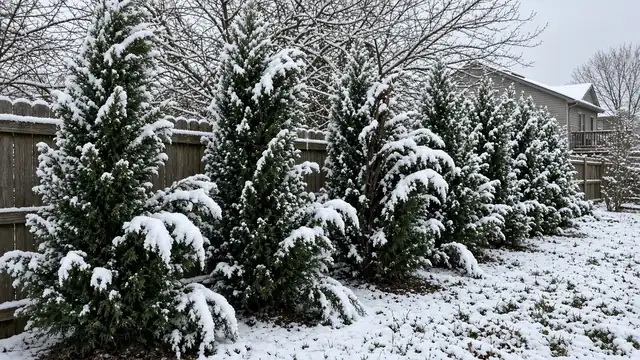
Upright, multi-stemmed arborvitae catch heavy, wet snow between their stems and splay open. an Ask Extension expert answer says columnar types such as 'Green Giant,' 'Emerald Green' and 'DeGroot's Spire' have become popular for screens and living fences but don't stand up well to heavy snow or ice loads. Ocean County gets its share of heavy nor'easter snow: Brick Township measured 30 inches in the December 2010 storm, the greatest total of that event (National Weather Service Mount Holly storm summary). For trees in the same yard, see ice- or snow-damaged tree: save or remove.
Sort the damage: bent, broken or done
| What you see | What to do | Source |
|---|---|---|
| Branches bent or splayed but not broken | Usually wait; most recover on their own over months. | K-State; Chicago Botanic Garden |
| A few branches snapped, split or with torn bark | Prune them out cleanly below the damage or back to a main branch. | K-State; Chicago Botanic Garden; UW-Extension |
| Main leader broken | Cut away the damaged part; expect a long wait for a new leader, or replace. | UW-Extension |
| More than half the plant broken, with damage at the base | Remove and replace the plant. | UW-Extension |
| Plant flattened to the ground | Likely damaged at the base; it may not straighten. | UW-Extension |
General extension guidance, not a diagnosis of your plant.
Need a tree looked at or priced? Request a free quote in about a minute.
Get a free quoteTo tie or not to tie
This is where the experts split. K-State Research and Extension advises against pulling, tying or staking bent branches back into place, saying the limbs can become dependent on the support rather than their own wood. an Ask Extension expert answer says branches that are simply bent may be trained back into position, as long as the ties stay on no more than two seasons, because forgotten ties eventually girdle and kill branches. University of Wisconsin-Extension horticulture educator Vijai Pandian also describes tying bent branches together with flat straps at several heights, and staking young, leaning plants by the main stem with a wide canvas strap for at least a full season.
A reasonable middle path: leave lightly bent plants alone, and only tie or stake badly splayed or leaning ones, using soft, wide material (never wire), with a reminder to take it off.
Pruning broken stems
Broken branches can't repair themselves. K-State Research and Extension says to remove limbs that are broken, split or damaged, and that the opening lets in sunlight so new growth slowly fills in. Chicago Botanic Garden says to prune broken or split branches back to a main branch. For branches with torn bark, University of Wisconsin-Extension horticulture educator Vijai Pandian recommends examining them carefully before pruning, because hasty cuts can tear more bark. If you can't do the work safely from the ground or a small stepladder, the Ask Extension answer says it's time to call a professional.
Chicago Botanic Garden also says to call a certified arborist for branches creating hazardous conditions, or the utility if wires are involved (see tree on a power line after a storm).
Prevent it next winter
- Wrap in fall. K-State and Ask Extension both recommend wrapping or tying smaller, upright evergreens before the first snow with soft cord, landscape wrap, heavy cloth strapping tape or similar, so branches stay together and upright.
- Take it off in spring. Both stress removing the wrap once the snow threat has passed. Left on, supports weaken limbs.
- Brush, don't beat. Gently brush fresh, powdery snow off with a broom. K-State says to wait for ice or frozen-on snow to melt, because knocking it off breaks branches and pulls off needles.
Salt spray and winter sun cause a different kind of damage on shore evergreens: see winter burn and salt damage on shore evergreens. For pruning or removing a damaged screen, see tree trimming and pruning and tree removal.
FAQ
Will my arborvitae straighten up after heavy snow?
Usually, if the branches are bent but not broken. K-State Research and Extension says bent evergreens like arborvitae will right themselves in most cases, though it may take six months to a year, and Chicago Botanic Garden says bent branches slowly return upright without help in most cases.
Should I tie my bent arborvitae back together?
Experts disagree. K-State recommends not pulling, tying or staking bent branches, because the limbs can become dependent on the support. An Ask Extension expert says branches that are simply bent may be trained back with ties, as long as the ties stay on no more than two seasons. If you tie, use soft, wide material and remove it on schedule.
When should I replace a snow-damaged arborvitae?
When the damage is structural. A University of Wisconsin-Extension educator says that if more than half of an arborvitae has broken branches with substantial damage at its base, it's best to remove the entire plant. A broken main leader can also leave a gap that takes a long time to fill.
How do I keep arborvitae from splitting in the snow?
Wrap or tie upright arborvitae in fall, before the first snow, with soft cord, landscape wrap or cloth strapping tape, and remove it in spring, per K-State and Ask Extension. Gently brush fresh, powdery snow off; don't knock off ice.
Sources
- K-State Research and Extension
- an Ask Extension expert answer
- Chicago Botanic Garden
- University of Wisconsin-Extension horticulture educator Vijai Pandian
- National Weather Service Mount Holly storm summary
More from the blog
- Tree on a power line
- Ice-damaged tree: save or remove
- Tree fell on my car (NJ)
- Cutting a fallen tree yourself
- Southern pine beetle
- Brush & stump disposal
- Ice & snow load tree prep
- Fall cleanup before the first freeze
- Emerald ash borer
- Nor'easter tree damage
- 24/7 emergency tree removal
- Tree fell on my house (NJ)
- Stump grinding cost by size
- Leaning or split tree after a storm
- Stump sprouts & replanting
- Emergency tree removal: what to expect
- Fall pruning: what not to cut
- Winter burn & salt on evergreens
- Firewood from your trees
- 2026 tree removal prices
- Tree permits by town
- JCP&L and trees near wires
- Pines & oaks that fail in storms
- Insurance and tree removal
- Neighbor's overhanging branches
- Japanese black pine decline
- Storm tree cleanup: who hauls what
- Stump grinding cost in Toms River
- Spongy moth and your oaks
- How to check a tree company's license
- Pinelands tree clearing rules
- Nor'easter tree checklist
- Best time to remove or trim trees
- When a neighbor's tree falls
- All posts
Cost and permit guides
- Tree Removal Cost
- Stump Grinding Cost
- Tree Trimming Cost
- Storm Damage & Insurance
- Tree Permits by Town
- Dead Pine Trees
- Storm-Proofing Trees
- Hazard Tree Assessment
- Dying Ash & Oak Trees
- Crane Removal Cost
Sources are linked in the text and can change. This is general information, not legal, insurance or professional advice. Free referral service, not a tree company. We'll work to connect you with no more than one independent local tree company, which may pay us for the referral.