Published November 23, 2026 · Ocean County Tree Service
Why storm cleanup is riskier than ordinary cutting
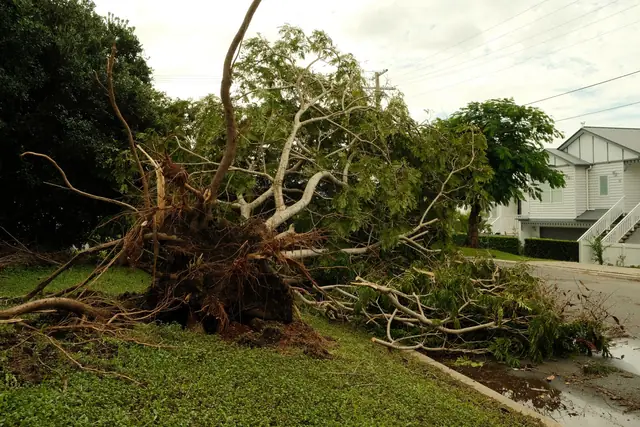
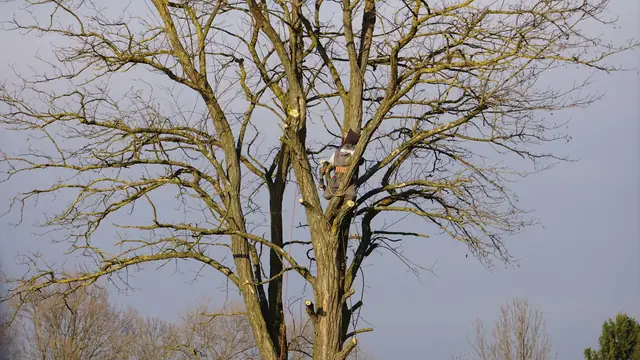
The CDC's chain saw safety page says the potential for injury increases after hurricanes and other natural disasters, when chain saws are widely used to remove fallen and partly fallen trees, and that it's best to have an operator with training and experience do the work. Storm wood is unpredictable: trunks are twisted, limbs are pinned under other limbs, and wood that looks loose may be loaded like a spring. OSHA's Working Safely with Chainsaws fact sheet lists higher-risk operations where accidents happen when people work beyond their skill level: trees on unstable ground or steep slopes, trees with a heavy lean, trees with stem or root rot, trees known to split, and running a saw above shoulder height or above ground level, such as from a ladder or tree.
Homeowner job or crew job?
| Situation | Who should handle it | Why |
|---|---|---|
| Small limbs lying flat on the ground | Homeowner with proper gear | Cut at waist height or below with good footing. |
| Anything touching or near a wire, including your service drop | The utility first, then a crew | Assume it's live and stay at least 30 feet back. |
| Limb or trunk bent, twisted or pinned (a spring pole) | Crew | Can release with enough force to cause serious injury or death, even at about 2 inches thick (CDC). |
| Hangers: broken limbs still up in the tree | Crew | OSHA flags "hangers" and "widow-makers" that can fall into the work area. |
| Tree resting on the house, car or fence | Crew | Needs rigging so a cut doesn't drop weight onto the structure. |
| Uprooted or heavily leaning tree | Crew | OSHA lists heavy leans and unstable ground as higher-risk work. |
| Any cut from a ladder or above your shoulders | Crew | OSHA lists it as higher-risk; the CDC says cut at waist level or below. |
Based on CDC chain saw safety guidance and OSHA's Working Safely with Chainsaws fact sheet.
If the tree is on a wire, nothing else matters until the utility clears it: see tree on a power line after a storm. If it's on the house or car, see tree fell on my house: what to do or tree fell on your car: who pays.
Need a tree looked at or priced? Request a free quote in about a minute.
Get a free quoteIf you do cut it yourself: the checklist
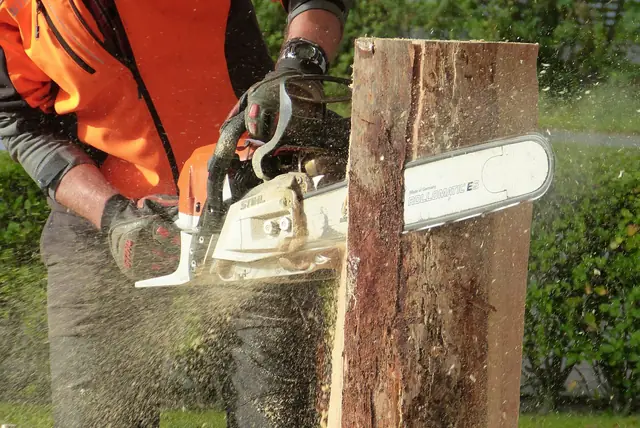
- Gear: the CDC lists a hard hat, safety glasses, hearing protection, heavy work gloves, cut-resistant chaps that run from the waist to the top of the foot, and boots that cover the ankle.
- The saw: a sharp, lubricated chain at the correct tension, and safety features such as a chain brake, front and rear hand guards, stop switch, chain catcher and spark arrester (CDC). Start it on the ground or other firm support with the brake engaged (OSHA).
- Distance: other people at least 30 feet from anyone cutting limbs or a fallen tree, and at least two tree lengths (at least 150 feet) from anyone felling a tree (CDC).
- Never work alone (OSHA), and take breaks: OSHA notes that fatigue increases the risk of injury.
- Height: cut at waist level or below (CDC), and don't cut directly overhead (OSHA).
- Kickback: keep both hands on the handles and avoid cutting in the kickback zone, the upper tip of the bar (OSHA).
- Fuel: refuel at least 10 feet from ignition sources (OSHA).
- Look before you cut: check for nails, cables or other metal in the wood and the debris (CDC, OSHA), and clear cut wood as you go so you keep an escape path (CDC).
Spring poles: the cut that hurts people
The CDC's chain saw safety page calls out "spring poles": trees or branches that have been bent, twisted, hung up or caught under another object in high wind. If one is suddenly released, it can strike the person cutting it, or a bystander, with enough force to cause serious injury or death, and the CDC notes that even a branch about 2 inches in diameter can do it. Its advice is to find the point of maximum tension and slowly shave the underside rather than cutting straight through, so the tension releases gradually. If you can't tell which way a piece is loaded, don't cut it.
Licensing, hiring and hauling
New Jersey's tree licensing law doesn't apply to a person who doesn't offer tree care services for hire (N.J.S.A. 45:15C-31), so you don't need a license to cut up a tree on your own property. Anyone you pay is different: the NJ Board of Tree Experts requires every business providing tree care for hire to register, keep at least one licensed person working full time, and display its NJTC number on its service vehicles. After big storms, ask for that number and a certificate of insurance before anyone starts (how to check a NJ tree company's license).
Once it's cut, the wood has to go somewhere. Town curbside pickup usually has size limits; see storm tree cleanup: who hauls what for Toms River and Brick rules, or have a crew chip and haul it as part of a tree removal job. Still standing but damaged? Read leaning or split tree after a storm or ice- or snow-damaged tree: save or remove first.
FAQ
Is it safe to cut up a fallen tree myself after a storm?
Small limbs lying on the ground, cut at waist height or below with proper gear, are a reasonable homeowner job. The CDC says it's best to have a trained, experienced chain saw operator remove fallen trees, and OSHA lists heavy leans, unstable ground, rot and cutting above shoulder height as higher-risk work. Anything touching a wire, hung in another tree, bent under tension or resting on a house is a job for a crew.
What is a spring pole?
A tree or branch that's bent, twisted, hung up or caught under another object, usually by high wind. The CDC warns that if it's suddenly released it can strike with enough force to cause serious injury or death, even if it's only about 2 inches in diameter.
How far away should people stay when I'm using a chain saw?
The CDC says at least 30 feet from anyone using a chain saw to remove limbs or a fallen tree, and at least two tree lengths (at least 150 feet) from anyone felling a tree.
Do I need a license to cut trees on my own property in NJ?
No. New Jersey's tree licensing law doesn't apply to a person who doesn't offer tree care services for hire (N.J.S.A. 45:15C-31). Any business you pay must be registered with the NJ Board of Tree Experts.
Sources
- CDC's chain saw safety page
- OSHA's Working Safely with Chainsaws fact sheet
- N.J.S.A. 45:15C-31
- NJ Board of Tree Experts
More from the blog
- Tree on a power line
- Ice-damaged tree: save or remove
- Tree fell on my car (NJ)
- Snow-damaged arborvitae
- Southern pine beetle
- Brush & stump disposal
- Ice & snow load tree prep
- Fall cleanup before the first freeze
- Emerald ash borer
- Nor'easter tree damage
- 24/7 emergency tree removal
- Tree fell on my house (NJ)
- Stump grinding cost by size
- Leaning or split tree after a storm
- Stump sprouts & replanting
- Emergency tree removal: what to expect
- Fall pruning: what not to cut
- Winter burn & salt on evergreens
- Firewood from your trees
- 2026 tree removal prices
- Tree permits by town
- JCP&L and trees near wires
- Pines & oaks that fail in storms
- Insurance and tree removal
- Neighbor's overhanging branches
- Japanese black pine decline
- Storm tree cleanup: who hauls what
- Stump grinding cost in Toms River
- Spongy moth and your oaks
- How to check a tree company's license
- Pinelands tree clearing rules
- Nor'easter tree checklist
- Best time to remove or trim trees
- When a neighbor's tree falls
- All posts
Cost and permit guides
- Tree Removal Cost
- Stump Grinding Cost
- Tree Trimming Cost
- Storm Damage & Insurance
- Tree Permits by Town
- Dead Pine Trees
- Storm-Proofing Trees
- Hazard Tree Assessment
- Dying Ash & Oak Trees
- Crane Removal Cost
Sources are linked in the text and can change. This is general information, not legal, insurance or professional advice. Free referral service, not a tree company. We'll work to connect you with no more than one independent local tree company, which may pay us for the referral.