Published October 19, 2026 · Ocean County Tree Service
Why there are so many black pines here
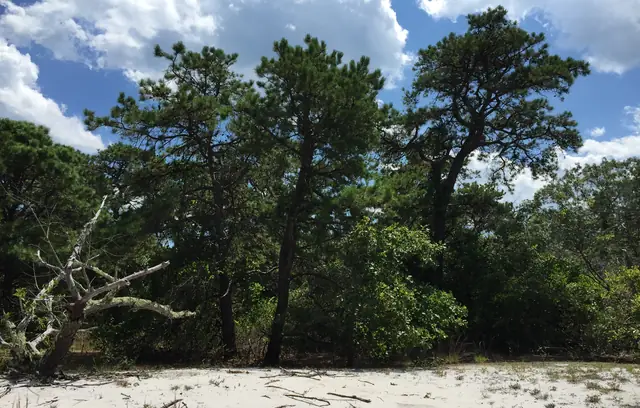
Japanese black pine (Pinus thunbergii) tolerates salt spray, wind and pure sand better than almost anything else, so it was planted widely along the Mid-Atlantic coast to hold dunes and screen yards. a Delaware study in the Journal of Nematology (1982) notes it was planted along Delaware's beaches for exactly those reasons, and one LBI landscaping company says seedlings were handed out to replant Long Beach Island after the Great Storm of 1962. Many of those trees are now 50-plus years old, and they're dying in large numbers on LBI, the Barnegat Peninsula and bayfront neighborhoods.
What's killing them
- Pine wilt (pinewood nematode): microscopic worms (Bursaphelenchus xylophilus) carried by pine sawyer beetles. They clog the tree's resin canals and can kill a black pine within one season. The Delaware study found the nematode was the major cause of Japanese black pine death there, and the International Society of Arboriculture's journal describes pine wilt as sudden death with reddish-brown needles that stay on the tree.
- Bark beetles and blue-stain fungus: Cornell Cooperative Extension of Nassau County describes black turpentine beetles attacking the lower trunk, leaving pitch tubes, often carrying a blue-stain fungus that speeds the tree's death. Engraver beetles also attack stressed pines.
- Scale insects: Rutgers Plant & Pest Advisory says Maskell scale and pine oystershell scale are major problems for black pine in New Jersey, especially in southern and coastal counties, causing needle browning, branch dieback and sometimes death.
- Stress: drought, salt-soaked soil after storm surge, and age make all of the above worse.
Need a tree looked at or priced? Request a free quote in about a minute.
Get a free quoteSigns your black pine is in trouble
- Needles turning yellow-green, then reddish-brown, sometimes across the whole tree within weeks (typical of pine wilt).
- Branch-by-branch browning and thin, sparse needles, often with small white or grey scale specks on the needles.
- Pitch tubes (blobs of resin) or reddish boring dust on the lower trunk.
- Small round exit holes in the bark of dead or dying trees.
Can it be saved?
It depends on the cause. Scale problems caught early can often be managed by a licensed tree care company. A tree that has turned brown all over from pine wilt cannot be saved. The practical control is prompt removal, so beetles emerging from the dead wood don't carry the nematode to nearby pines. Don't keep or move the wood as firewood, and ask the company to chip or haul it away. Dead pines also dry out and get brittle fast, which makes them dangerous in nor'easters and more expensive to remove later.
What to plant instead
Instead of another Japanese black pine, consider salt-tolerant natives that suit barrier-island conditions, such as eastern red cedar, pitch pine, American holly, bayberry or beach plum. Mixing species keeps one pest from wiping out the whole screen. Some towns, including Long Beach Township, Ship Bottom and Beach Haven, also require replacement planting when larger trees are removed, so ask what species they accept.
Permits and local pages
Most barrier-island towns now require a permit before removing trees 6 inches or more across, though dead and dying trees are usually treated as hazard trees. See Long Beach Township, Ship Bottom, Surf City, Beach Haven, Seaside Park and Seaside Heights, plus our dead pine guide and dead tree removal.
Why are Japanese black pines dying on Long Beach Island?
The main causes reported in the region are pine wilt (the pinewood nematode carried by pine sawyer beetles), bark beetles with blue-stain fungus, and scale insects, made worse by age, drought and salt stress.
Can a brown Japanese black pine be saved?
If the whole tree has turned brown, usually not, especially with pine wilt. Remove it promptly and chip or haul the wood away so beetles don't spread the nematode. Early scale problems can sometimes be treated.
What should I plant instead of Japanese black pine?
Salt-tolerant natives such as eastern red cedar, pitch pine, American holly, bayberry or beach plum, ideally mixed so one pest can't take out everything.
More from the blog
- Nor'easter tree checklist
- Best time to remove or trim trees
- When a neighbor's tree falls
- Spongy moth and your oaks
- How to check a tree company's license
- Pinelands tree clearing rules
- Storm tree cleanup: who hauls what
- Stump grinding cost in Toms River
- All posts
Cost and permit guides
- Tree Removal Cost
- Stump Grinding Cost
- Tree Trimming Cost
- Storm Damage & Insurance
- Tree Permits by Town
- Dead Pine Trees
- Storm-Proofing Trees
- Hazard Tree Assessment
- Dying Ash & Oak Trees
- Crane Removal Cost
Sources are linked in the text and can change. This is general information, not legal, insurance or professional advice. Free referral service, not a tree company. Your request goes to one independent local tree company, which may pay us for the referral.